Zeus. That’s it. Just Zeus. The only name I remember from grade school Greek mythology.
The way I figured it back then, I knew God the Father, Jesus the Christ, and the Holy Ghost. What need could I possibly have to know the names of Greek and Roman gods?
Decades later I landed on a reason: Jesus knew their names. All of them. No kidding.
Consider this: after Jesus multiplies a boy’s five barley loaves and two small fish to feed a large crowd, He puts some distance—the Sea of Galilee—between himself and his disciples, and the crowds. But ten miles is not too far for the crowds to walk so they catch up with him the next day. Maybe after dishing out the best-ever fish and bread meal, He’ll serve us fresh bagels and cream cheese this morning.
Jesus, however, has different intentions as the sun rises. As they gather around He says to them, “I am the bread of life.” Now unless we know our Roman gods, we don’t see these as fighting words. But there were people in His audience who would have looked at each other with raised eyebrows, “Did He just challenge Ceres?”
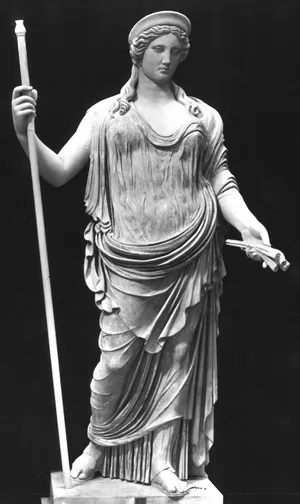
Who’s Ceres? She’s the Roman goddess of agriculture and grain crops. Credited with the discovery of spelt wheat, she brought the gift of agriculture to humankind. Today, we get the word “cereal” from her name. In the 1st century though, Romans believed you literally got cereal from her. Ceres was their bread of life.
But then Jesus shows up and has the audacity to call her an outright counterfeit: “Is it bread you want again today? Trust in me as your Provider and you’ll get true bread, life-giving bread, straight from the heavens. Ceres can’t deliver you that.”
Seven times in John’s gospel Jesus confronts the gods of the current age.
In fact, Jesus’ second “I am” statement brings up the one god I knew: Zeus. He was the father of Apollo who the Greeks considered the god of light. When Jesus says “I am the light of the world” he is defying Apollo and telling the Romans, “Unless you like bumbling around in darkness, follow me, not Apollo. Only then will you have the light of life.”
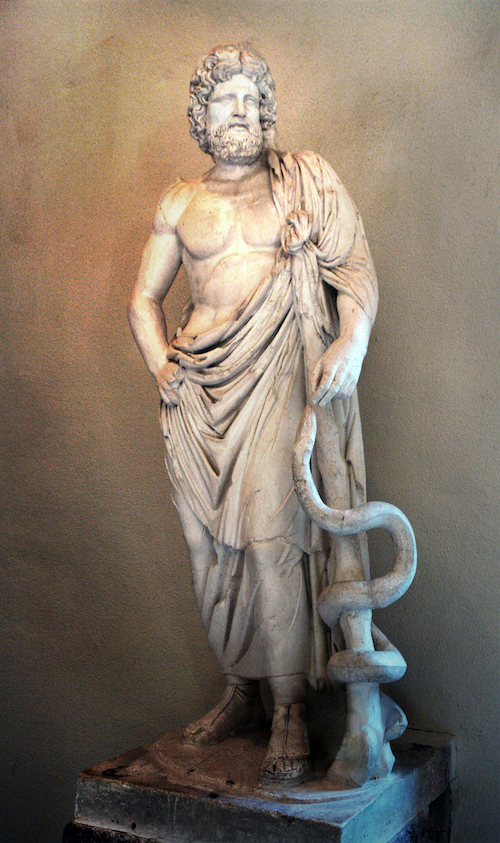
Jesus, continuing down the family tree of gods, also stands against Apollo’s son Asclepius who was instructed in the ways of healing. He was considered the god of medicine. When Jesus says to Martha, “I am the resurrection and the life,” Asclepius probably hopes nobody is eavesdropping on their conversation. But then word starts to spread that walking-talking-breathing-again Lazarus might just have more life in him than good ol’ Asclepius. Eek!

Janus was a two-faced god. I like this picture of him: one face looking backward and one looking forwards. He was the god of gates, doorways, and transitions. We get our word January from this god because January is the doorway from one year to the next.
To this god, Jesus seems especially aggressive. He says, “I am the gate (or door) for the sheep. All who have come before me are thieves and robbers.” These are not the utterances of someone concerned about getting invited to a New Year’s party. No Roman would have wondered who Jesus was facing up to.
Now if you’re a shepherd who’s alone in the wilderness with your flocks, it’s reasonable to think you want a god who can protect you from things that go bump (or roar!) in the night. The Greeks believed Pan—the part-goat, part-man god of the wild, shepherds and flocks—could do that.
“But I tell you the truth,” says Jesus, “I am the good shepherd. When death creeps into the valley and evil slithers up the hill, I will lay down my life for the sheep. The mere sight of a wolf will cause all the others to abandon the sheep and run away.” Basically, Jesus calls Pan an unreliable scaredy cat goat.
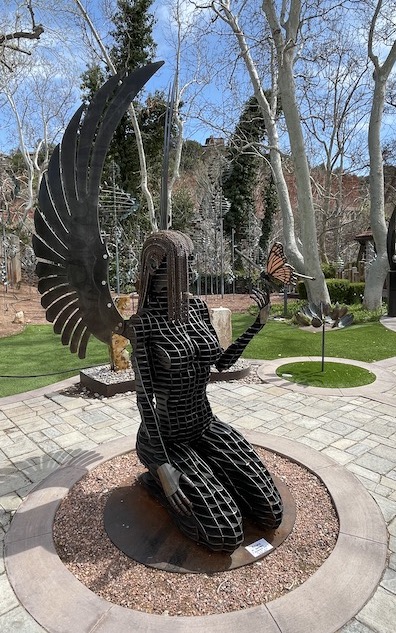
Then there’s Athena, the Greek goddess of wisdom and truth. For any Roman wanting to know how to get to god, Athena is your ticket. Seek her counsel for the way to go. Keep in mind though that she is also the goddess of warfare. But her helmet or spear do not concern Jesus. He doesn’t hold back—”I am the way and the truth and the life. If you want to come to the Father, the only way is through me.” Them are fighting words.
In John’s gospel, the final god Jesus confronts is Dionysus (aka Bacchus). Dionysus was the god of wine-making, orchards and fruit. Nice. Who doesn’t like fresh fruit? He was also the god of orgy, insanity, and ritual madness. Oh. “Everything you’re looking for or looking to escape from when you worship Dionysus,” Jesus says, “you can find in me. I am the true vine. Remain in me and you will share in the liveliest of feasts.”
I’m familiar with gentle Jesus, meek and mild toward the little children, the weary and heavy-laden. And I know about fed-up Jesus taking every opportunity to dress down the Pharisees.
But this was new to me: confrontational Jesus repeatedly calling into question the gods of His culture.
Luckily, we’re now so much more enlightened. A god of doors? Pfft, ridiculous! I bet God is relieved He doesn’t have to do that sort of correctional thinking and confrontation anymore.
I mean we have telescopes to tell us Apollo isn’t the god of light. The sun has no god. Sure, that star can be thought of as the light of the world. No wait, scratch that. We are the light of the world. We are the city on a hill. We are a thousand points of light. At least that’s what we say in America.
And we no longer need to appease Asclepius for medicine. We have scientifically-proven creams, cures, calcium supplements, and if those fail, there’s CBD. Whee!
And who among is a shepherd in the wilderness anymore in need of Pan’s protection? The boogeyman isn’t real. There aren’t monsters under our beds. We can slay our own dragons.
And we can open our own doors, thank you very much. We don’t need Janus looking both ways for us. We’ll rely on our connections, network, or contributions to get ahead.
And Ceres isn’t the one pouring our cereal. We have SUPERmarkets and Costco now. If we get scared, we can always hoard TP, eggs, and boxes of Cheerios in our closets.
And we don’t need the truth or wisdom offered by Athena. We’ll make our own way. Blaze our own trail.
Are we really more advanced in our thinking, or simply more arrogant?

Is it possible that every mythological Greek god has been replaced in the last two thousand years by an even more narcissistic god—us? The Greeks of old at least had enough sense to know that some things were outside of their control. We don’t seem to exhibit such understanding.
Instead we laugh and say that those who had festivals for Dionysus were fools. Who would binge on wine, entertainment, food, athletics, or work? Wait a minute. Are we that different in thinking just a few more minutes of scrolling, shopping, or streaming will numb our pain?
Indeed, we are participants of ritual madness.
I am a 21st century believer of mythologies. Trying to appease the gods of provisions, transitions, and illuminations.
Jesus knows them all by name. Every god I trust more than Him.
The choice is mine: lay them down on my own accord, or watch the I AM topple each one.
Oh Jesus, I need light!
Save me from the seduction of lesser gods.
Center me in your way, your truth, and your life before I wreck myself.
Good Shepherd, do not leave me alone to fight the dragons. Direct my going outs and coming ins for my good and Your glory.
Bread of Life, be near.
Resurrect in my life everything that has prematurely died.
Jesus, Son of the Most High, come quickly and be my only God.
- Jesus’ “I am” statements can be found in John 6, 8, 10, 11, 14, and 15.
- For more about how Jesus’ seven “I am” statements confronted the Greek and Roman gods, check out Marty Solomon’s BEMA Podcast #87. It’s ridiculously wonderful and mind blowing. 🤯
- Here’s an tasty tidbit about Asclepius. For showing kindness to a snake, the snake “licked Asclepius’s ears clean and taught him secret knowledge. To the Greeks, snakes were sacred beings of wisdom, healing, and resurrection.” Anybody else hearing Genesis-like echos of snakes whispering so-called wisdom? 😉
 Lord, Come Quickly