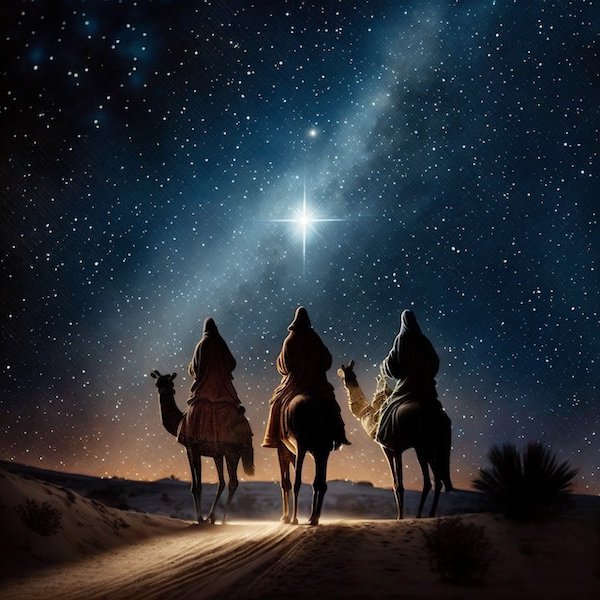
After Jesus was born in Bethlehem in Judea, during the time of King Herod, Magi from the east arrived in Jerusalem, asking, "Where is the One who has been born King of the Jews? We saw His star in the east and have come to worship Him."

When King Herod heard this, he was disturbed, and all Jerusalem with him. And when he had assembled all the chief priests and scribes of the people, he asked them where the Christ was to be born.

"In Bethlehem in Judea," they replied, "for this is what the prophet has written:
'But you, Bethlehem, in the land of Judah,
are by not means least among the rules of Judah,
for out of you will come a ruler
who will be the shepherd of My people Israel.'"

Then Herod called the Magi secretly and learned from them the exact time the star had appeared. And sending them to Bethlehem, he said: "Go and search carefully for the Child, and when you find Him, report to me, so that I too may go and worship Him."

After they had heard the king, they went on their way...1
As they went on their way, do you suppose it sounded anything like this…
***
“Can we stop in the bazaar on the way out of town for a baby gift?” asked the youngest of the Wisdom Seekers.
“Absolutely not!” came the stern reply from the front of the caravan. “We are leaving this so-called City of Peace now. There’s not an ounce of peace to be found in this place.” The eldest of the Wisdom Seekers was tired, but more than that, he was confounded. He wanted the quiet of the open road to sort through all that had happened in the king’s palace.
“But I’m thinking my gift of myrrh might be offensive,” said the younger one pulling up alongside. “What babe or new mother wants to open a box and smell ingredients meant for embalming the dead? Maybe I should purchase some blankets instead.”
The old man shook his head. “No, your myrrh might, unfortunately, be the perfect gift.” Seeing as the young man did not understand, he added, “Didn’t you see the anger behind the King’s eyes when we left his palace?”
“He said he wanted us to get the exact address so he too could go worship the new king,” stammered the younger one.
“Worship! Are you serious?” came the loud retort. “Herod nearly choked on the word ‘worship.’ Don’t be an idiot!”
“Alright you two,” injected the lady Wisdom Seeker and unofficial peacemaker of the group. Maneuvering herself between the two of them, she continued, “We’re not making any stops, for blankets, bread, or otherwise. And can we please wait until we’re away from the crowds before talking about this anymore.”
She was right, of course. A caravan of their size from Persia wasn’t going to easily slip in and out of Jerusalem. People noticed. And people talked. None of it nice. Everyone seemed suspicious and on edge. Peace was something this city was very much lacking. So the Wisdom Seekers ceased their conversation, waiting until the city gates were well behind them.
The lady seeker spoke. “The star definitely led us to Jerusalem, but it wasn’t anything like I expected.”
“Yeah,” agreed the young seeker. “I expected the palace to be filled with baby stuff. All the finest clothes and linens as well as nursemaids and educators ready to raise the new infant king.”
“Nothing about it makes sense,” ruminated the elder seeker. “We clearly weren’t expected. They should have been prepared to receive dignitaries coming to offer well wishes and congratulations to a new king. Where were the flowers? the feasts? the parades? It wasn’t like we were late to the party. There was no party at all.”
“And did you see King Herod’s expression when we asked about the one who had been born King of the Jews? He clearly wanted to say ‘Here I am!'” exclaimed the lady seeker spreading her arms wide and giving a royal wave.
That got a chuckle out of the younger one.
Then continuing, “Maybe they were unaware of a new king’s birth.” She stopped, staring off into the distance for several moments. “No, that can’t be. Herod himself may have initially been unaware, but after meeting with the chief priests behind closed doors, he told us to head to Bethlehem. So they clearly know something.”
“Or maybe they’re guessing,” said the elder seeker. “I can’t figure out if they’re sending us in a known direction, in exactly the opposite direction, or the quickest direction out of town.”
The young seeker smiled and piped in, “In any case, those gray-haired teachers certainly didn’t appreciate us nosing around.”
“Of course not,” replied the elder seeker shaking his own head of gray hair. “Their law forbids astrology as a form of divination.”
“Yeah, that old chief priest sure was quick to remind you of that, wasn’t he?” laughed the young seeker.
The elder seeker huffed. “I would have liked to remind him about a thing or two. Like the fact that his own Torah references a star rising out of Judah. But he didn’t seem in the mood to be enlightened.”
“No,” said the lady seeker smiling. “He definitely did not want to hear anything remotely starry or enlightening from the likes of you.”
They all laughed at that.
Onward their camels walked, headed south. The sun cast their shadows long on the sand.
After a bit, the elder seeker said seriously, “The chief priests and teachers of the law might have outwardly scoffed at us, but everyone there was greatly disturbed. There are some within the walls of Jerusalem—and likely some within the walls of the palace—who believe that comets and other heavenly signs foretell the demise of rulers. That could spell trouble for King Herod.”
The lady seeker finished his thought. “And you know how paranoid the King is. If he gets an inkling that there’s a threat to his throne, he won’t hesitate to spill blood.” She stopped short thinking about the King’s wife Marianne, his two sons, and his brother-in-law, all executed.
“So that’s why you said my baby gift might be…tragically perfect,” said the young seeker quietly.
“Exactly. Herod the Great is a violently jealous king. He will not allow some new king—born under a star or not—to dethrone him,” confirmed the elder seeker. But why, he wondered to himself, why would there be such a brilliant display, such an unprecedented sign in the heavens if the new king’s life would end in an early death. What’s the reasoning?
As the sun dipped below the horizon, the air suddenly felt very cold.
Wrapping his cloak tighter, the young seeker inquired, “Don’t you think some of the teachers of the law are just a wee bit curious? Micah’s prophesy was 700 years ago, but what if it’s finally being fulfilled. Wouldn’t they want to know?”
“All they’d have to do is walk six miles!” said the lady seeker. “We’ve travelled over 700 miles—or is it 800 by now—either way, six measly miles and they’d know,” raising her hand, she panned across the sky, “if the Creator of the Stars has actually arrived beneath His stars.”
She sighed, then added, “Or at least they could have sent one of their disciples to tag along with us?”
“Well, I don’t think that’s going to happen,” said the young seeker looking over his shoulder. “No one is following us.”
“Maybe they’re more afraid than curious,” said the elder seeker.
“What’s there to be afraid of?” asked the young seeker. “Only the King’s throne is in jeopardy.”
“Everyone’s got a throne,” said the elder seeker. “It may not literally be set up in the King’s Court or have a lion’s head carved in the arm of it, but everyone has one. Maybe it’s their place in the community or in their household. Or maybe in their synagogue or in their business. A new king will disrupt all the thrones.
“Look at how he has disrupted ours lives the last two years. A king we’ve never even met or ever heard a word from has upended our time, money, work, and families. Some people, maybe most people, won’t like that kind of intrusion.
“The current structure perfectly suits them, their pocketbook, their lifestyle, and their seat of power. For them, a new king is bad news, not good. And that makes them very afraid.”
They were all quiet. Lost in thought.
How will this new king rule?
Who will he bless and who will he harass?
Will he turn the kingdom upside down? or right side up?
Will he even live long enough to do so?
“Maybe they aren’t curious or afraid,” said the lady seeker trying to lighten the mood. “Maybe all of Jerusalem thinks we’re just crazy star gazers out on a wild camel chase.”
“Maybe we are,” hooted the young seeker. “A bunch of ridiculous Babylonians searching for the King of the Jews. What a riot!”
“Have faith, my companions” assured the elder seeker. “I’ve been tracking the stars long before you were knee-high to a scorpion. The heavens themselves are declaring the greatest of glories. Believe!”
Each one recalled all they had noticed, tracked, and laboriously recorded, willing themselves to have faith for just a few more miles. Then…
“Look,” whispered the wisest of the Seekers with a smile on his lips. “There’s the star again.”
And they were overjoyed.
***
Joy. It fills the most unlikely people throughout the entire Christmas narrative.
Good things generally aren’t associated with the eastwardly direction in the Bible, and yet these magi from the east seek out and find joy embodied.
Of course there’s the unwed, pregnant teenager who finds her soul and spirit so full of “joy in God my Savior” that she writes a most magnificent song.
An old woman has her disgrace replaced with joy and claims a new identity: Once barren but now miraculously pregnant with a prophet.
An unborn child, to be named John meaning “graced by God,” dances for joy before even taking his first breath.
Then lowly, poor, and often despised shepherds are visited by angels and “welcome[d] at the manger [where] the outcasts became honored guests” at the holiest birthday party ever.2 They leave with hearts and mouths full of praise.
And an 84-year-old widow, who has spent decades on knobby knees, praying and fasting within the temple walls, becomes an eye witness to glory.
What’s the opposite of being joyfully delighted? Being deeply disturbed. That accurately describes King Herod’s response throughout the account.
But he wasn’t alone. The chief priests, professors, and the “holier-than-thou” were disturbed too. They knew the same Bible that Mary knew and Anna knew and Elizabeth knew. They all knew what the prophet Micah had written about Bethlehem, but the religious elite were filled with worry not joy. And “all of Jerusalem” with them.
That’s how it was at the first coming. I wonder, will it be the same at the second?
Will it be the young and the old, the lowly and the outcast, the unwed and the widowed, and those from unexpected places who will be filled with joy on that day? Whereas the heads of state, the religious upperclass, and all those who shine real good on the outside will be disturbed and dismayed?
The third week of Advent is marked by the candle of joy. It is a reminder that we do not have to be jealous of the joy experienced at the first Christmas or lose hope waiting for joy at the King’s second arrival. In Philippians it is written, “Rejoice…The LORD is near.” We can be filled with joy now.
Jesus the King is already here. His kingdom is already making significant inroads. And when the darkness threatens to edges out our joy, may we become like the Magi.
Seek Him out with all our heart, soul, mind, and strength.
Ask around if we need directions.
Have faith that He will guide us to Himself.
And when we then find the King, bow down and worship.
Lord, come quickly and complete our joy.
 Lord, Come Quickly